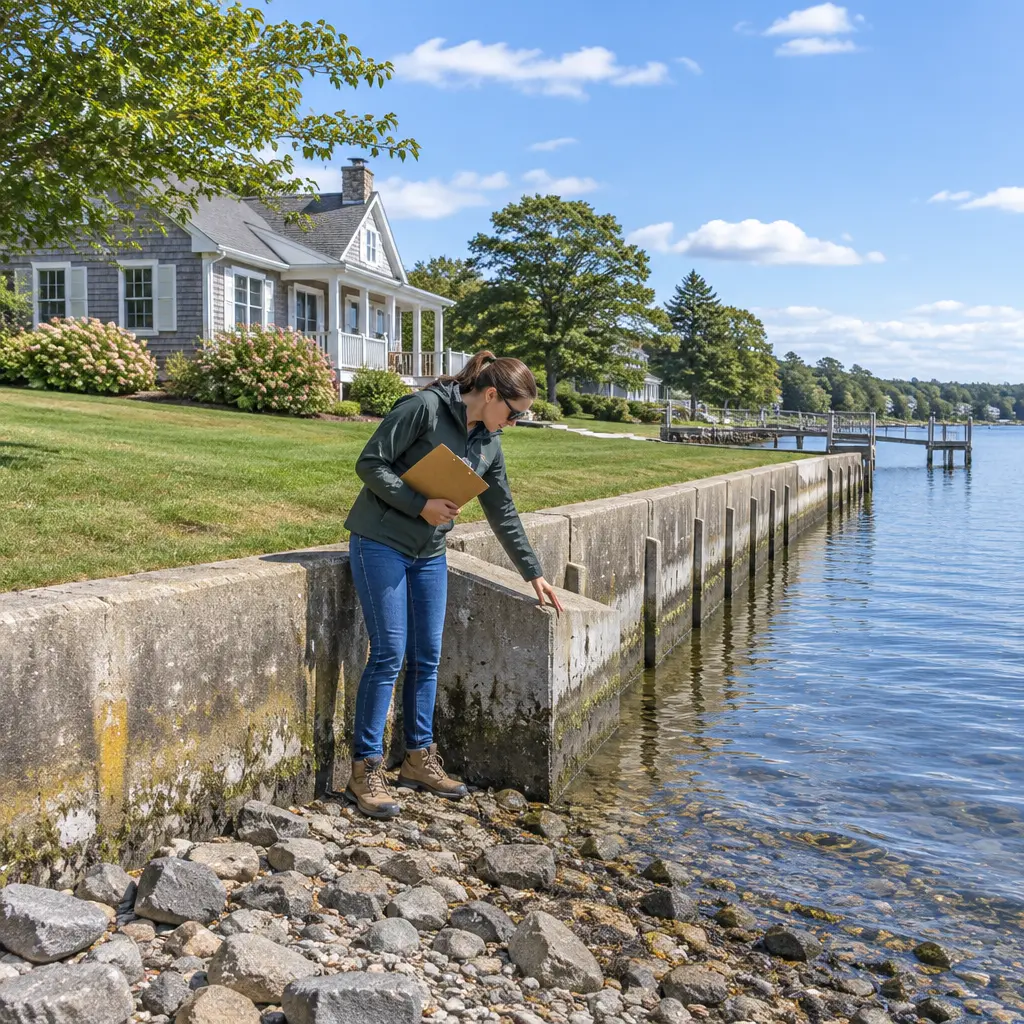
A waterfront home’s value is shaped not only by its view, but also by the condition, design, and remaining service life of the structure holding the land at the water’s edge. A seawall is a retaining structure that helps resist shoreline erosion and retain soil; its integrity can affect usable yard space, safety, maintenance costs, insurance considerations, and a buyer’s negotiating position. Because there is no single national seawall rating or repair-cost figure that applies to every shoreline, valuation should combine a qualified inspection, site-specific engineering evidence, local permitting and flood context, and documented repair estimates. This guide explains how to assess seawall integrity, distinguish common failure modes, incorporate findings into a property valuation, and verify the evidence before making an offer or setting a price.
Seawall integrity as a waterfront home valuation attribute
In real estate analysis, seawall integrity means the structure’s observed condition and demonstrated ability to perform its intended shoreline-retention function. The U.S. Army Corps of Engineers describes coastal structures such as bulkheads and seawalls as protective works whose performance depends on design, materials, loads, and site conditions. That is an engineering description rather than a universal real-estate grade: there is no single public standard that assigns every residential seawall a comparable numerical score. An appraiser or buyer should therefore treat “good condition” as a conclusion supported by inspection findings and records, not as a cosmetic label.
The attribute has several related forms, or hyponyms: structural condition, geotechnical stability, drainage performance, toe or foundation protection, material durability, and regulatory compliance. A sound-looking face may conceal failed anchors, voids behind the wall, or scour at its base. Conversely, a weathered surface does not automatically establish imminent failure. Valuation depends on the combination of visible evidence, engineering judgment, maintenance history, and the consequences of a defect for the parcel.
Structural condition and visible distress
Structural condition describes whether the wall’s panels, cap, joints, and connections remain intact and aligned. Inspectors commonly document cracking, open joints, leaning, bulging, displaced panels, corrosion, exposed reinforcement, damaged caps, and separation between the wall and adjacent ground. These observations are indicators to investigate, not standalone proof of failure: their significance depends on wall type, age, construction details, soil, water levels, and the rate at which conditions are changing.
A useful record includes dated photographs taken from consistent viewpoints, measurements of notable movement where feasible, and prior inspection or repair reports. Progressive movement or widening cracks can be more consequential than an isolated, stable surface crack. The American Society of Civil Engineers’ infrastructure assessments emphasize the importance of condition, performance, and investment needs; for a particular home, however, a licensed coastal or geotechnical engineer must evaluate whether observed distress threatens the structure’s function.
Geotechnical stability, drainage, and scour
Geotechnical stability concerns the soil and forces around the wall, including retained-earth pressure, groundwater, wave action, and the wall’s foundation or embedment. Poor drainage can allow water pressure to build behind a wall, while scour can remove supporting sediment at its base. Signs such as sinkholes, depressions, soil loss, recurring wet spots, or gaps behind the cap warrant further investigation because the visible wall face may not reveal the extent of hidden voiding or foundation loss.
The Federal Emergency Management Agency’s coastal guidance explains that waves, flooding, erosion, and changing water levels can affect shoreline properties and protective structures. Local exposure matters: a sheltered canal, an open bay, and an ocean-facing shore do not impose identical loads. A valuation review should connect the wall’s condition to the site’s water-level range, wave exposure, drainage pathways, and erosion history rather than assume that all waterfront locations carry the same risk.
Materials, age, and remaining service life
Material durability is the ability of the wall’s components to resist deterioration in their particular environment. Residential shoreline structures may use timber, steel, concrete, masonry, vinyl, or composite elements. Saltwater exposure can accelerate corrosion of susceptible metals; timber can deteriorate through biological processes; and concrete can crack or lose material. Actual service life varies substantially with design, installation, maintenance, water chemistry, exposure, and workmanship, so a generic age-based lifespan should not be treated as a condition assessment.
For valuation, the practical question is not merely “How old is the wall?” but “What work is likely to be required, when, and with what uncertainty?” Request construction plans, permits, invoices, warranties, and prior engineering reports. Where the remaining life is uncertain, an engineer may recommend testing or further investigation. A buyer can then distinguish routine maintenance from a near-term capital project and reflect that distinction in the offer, contingencies, or repair negotiations.
Inspection evidence connects seawall condition to property value
A seawall inspection is a condition assessment of the shoreline structure and its immediate setting. It helps convert a broad concern into evidence that an appraiser, buyer, seller, lender, or insurer can evaluate. The inspection should be performed by a qualified professional familiar with the local shoreline and wall type; where meaningful structural or soil concerns appear, a licensed coastal, civil, or geotechnical engineer may be appropriate. A general home inspection can identify visible concerns, but it should not be assumed to replace specialized engineering analysis.
Inspection findings influence value through several channels: anticipated repair or replacement expense, disruption during construction, loss of usable land, uncertainty about permitting, and perceived risk to the home or neighboring property. The effect is not necessarily equal to the contractor’s estimate. Market reaction depends on comparable waterfront sales, buyer demand, financing and insurance requirements, the severity and timing of work, and whether the wall is legally and practically repairable.
A practical inspection scope
A useful assessment records the wall’s construction type, approximate dimensions, alignment, visible distress, drainage features, shoreline exposure, adjacent ground condition, and any evidence of recent movement or erosion. The professional should state what was and was not accessible, identify limitations, and recommend next steps. Underwater components or concealed anchors may require specialist access or additional testing; a visual shoreline visit cannot reliably verify every hidden element.
- Photograph the entire wall and close-ups of cracks, joints, tiebacks, outlets, and damaged areas.
- Note depressions, soil loss, standing water, vegetation changes, and erosion near the wall’s base.
- Ask whether the findings indicate routine maintenance, monitoring, targeted repair, or a need for detailed engineering.
- Request an opinion on urgency and the consequences of delaying recommended work, where the professional can support one.
- Obtain written estimates from contractors experienced with the relevant shoreline conditions and construction method.
Permits, ownership, and compliance
Regulatory compliance is part of the wall’s practical value because shoreline work may be subject to local, state, and federal rules. Requirements depend on location, waterbody, project scope, habitat, and whether work involves fill, dredging, rebuilding, or changes to the shoreline. The U.S. Army Corps of Engineers administers federal permitting programs under Section 404 of the Clean Water Act and Section 10 of the Rivers and Harbors Act in applicable circumstances, while state and local agencies may impose separate requirements. These laws do not mean every repair needs the same permit; buyers should verify the rules for the specific property and proposed work.
Confirm who owns and maintains the wall, where the property boundary lies, whether access rights or easements apply, and whether prior construction was authorized. A wall that crosses a boundary or serves multiple parcels can create shared obligations. Request permit records and final approvals from the relevant agencies, and ask local officials or qualified counsel about unresolved compliance questions. A technically repairable wall can still present a valuation problem if approvals, access, or responsibility are unclear.
Flood, erosion, and insurance context
Flood and erosion exposure are related to, but distinct from, seawall condition. FEMA Flood Insurance Rate Maps identify mapped flood hazards for insurance and planning purposes; they do not certify that a seawall is sound or guarantee that a property will not flood. FEMA also cautions that flood risk can exist outside mapped high-risk areas. A buyer should check the property’s current map designation, elevation information where available, flood history, and insurance quotes, while separately assessing the wall and shoreline.
The National Oceanic and Atmospheric Administration tracks sea-level trends at tide-gauge locations, showing that local relative sea level varies by site and over time. Those records provide regional context, not a parcel-specific forecast or a direct estimate of a wall’s remaining life. For valuation, use the nearest relevant gauge and local coastal or flood studies as context, then rely on site-specific engineering for design implications.
Valuation methods translate seawall risk into a defensible price
Waterfront home valuation is the process of estimating market value from the property’s characteristics, condition, location, and market evidence. The seawall should be analyzed as a site improvement and a risk-bearing component—not as a substitute for evaluating the home, land, access, view, and comparable sales. The Appraisal Institute’s valuation framework distinguishes market evidence and property characteristics; in practice, an appraiser should explain how a documented seawall deficiency affects the relevant market rather than apply an unsupported blanket discount.
Comparable sales and market reaction
The sales-comparison approach looks at recent sales of similar properties and adjusts for meaningful differences. For waterfront homes, useful comparisons ideally share similar water access, shoreline exposure, lot configuration, view, flood context, and seawall condition. If a comparable property had a newly repaired wall while the subject has documented failure, that difference may matter; the adjustment should be supported by market evidence, cost information, or both, not by an arbitrary percentage.
Where local sales are limited, the appraiser may need to broaden the search and explain uncertainty. Relevant evidence can include listing histories, concessions, repair credits, time on market, and buyer or broker feedback. A strong view may support demand, but it does not erase a material structural liability; equally, a repairable defect may not eliminate the value premium associated with scarce waterfront access.
Cost-to-cure and uncertainty allowance
Cost-to-cure analysis estimates the expense of bringing a deficient wall to an acceptable condition. Obtain project-specific written estimates that distinguish investigation, design, permits, access, construction, site restoration, and contingency. The lowest bid may omit difficult access, environmental controls, engineering, or temporary protection, so compare scope as well as price. National averages are often misleading because shoreline construction costs depend on local labor, materials, water depth, exposure, permitting, and mobilization.
A simple valuation worksheet can show how the evidence is organized:
- Indicated value from comparable sales, adjusted for property-specific differences
- Less supported cost of immediate repair or replacement, if not already reflected in comparable-sale adjustments
- Less any market-supported allowance for uncertainty, delay, disruption, or unresolved permitting
- Plus or minus other property-specific factors, such as usable shoreline access or documented recent improvements
This is a framework, not a formula that guarantees market value. Avoid double-counting: if comparable sales already reflect similar wall problems, deducting the same repair cost again may overstate the adjustment. An appraisal should explain the selected method and reconcile the evidence.
Illustrative case: two homes with similar views
Consider two otherwise similar homes on the same sheltered waterway. The first has a recent engineering report, documented maintenance, and no material movement observed. The second has soil loss behind the wall, an uneven cap, and no records of construction or permits. Even if the homes offer comparable views, a buyer may treat the second property as carrying greater repair and approval uncertainty. The valuation response should be based on inspection findings, a scoped repair estimate, and local sales evidence—not simply on the visual difference or a presumed universal discount.
A useful graphic for a valuation report would be a condition-and-evidence matrix with columns for observed issue, professional interpretation, recommended action, cost range, timing, and valuation relevance. It makes clear which conclusions are verified, which remain uncertain, and which require follow-up.
A due-diligence sequence protects buyers and sellers
A disciplined review links the wall’s physical condition to ownership, approvals, cost, and market value. Buyers should begin early enough in the transaction to obtain records and specialist advice before contingencies expire. Sellers can reduce uncertainty by assembling documentation before listing and addressing significant concerns transparently.
- Collect available plans, permits, warranties, repair invoices, inspection reports, and maintenance records.
- Verify ownership, boundary location, easements, shared-wall obligations, and access rights.
- Arrange a site-specific inspection and escalate to engineering review when signs or history warrant it.
- Check local shoreline rules, flood information, erosion records, and insurance availability independently.
- Obtain written, scope-matched repair estimates and clarify what each estimate excludes.
- Compare the property with relevant waterfront sales and document how wall condition affects buyer demand.
- Use the findings to negotiate price, repairs, credits, contingencies, or further investigation.
For sellers, a dated condition report and complete permit history can help distinguish a maintained wall from an undocumented one. For buyers, the essential question is whether the available evidence is sufficient to price the risk. If it is not, seek more investigation or preserve a contractual option to renegotiate or withdraw, subject to the purchase agreement and professional legal advice.
Conclusion: price the shoreline structure, not just the view
Seawall integrity is a waterfront home valuation attribute that includes structural condition, soil and drainage performance, material durability, and compliance—not merely appearance. A qualified inspection establishes what is visible; engineering analysis addresses significant structural or geotechnical questions; permits and ownership records clarify whether work can be completed; and comparable sales plus scoped estimates show how the findings may affect price.
Because shoreline conditions and regulations vary by property, no generic lifespan, national repair average, or visual impression can replace site-specific evidence. Buyers and sellers should assemble records, inspect the wall, verify local requirements, and document the valuation reasoning. The result is a more defensible transaction that recognizes the value of waterfront access while accounting for the structure that helps make that access usable.
Sources: U.S. Army Corps of Engineers, Regulatory Program Overview, https://www.usace.army.mil/Missions/Civil-Works/Regulatory-Program-and-Permits/; U.S. Army Corps of Engineers, Coastal Engineering Manual, https://www.publications.usace.army.mil/USACE-Publications/Engineer-Manuals/; Federal Emergency Management Agency, Flood Maps and Zones, https://www.fema.gov/flood-maps; Federal Emergency Management Agency, Coastal Construction Manual, https://www.fema.gov/emergency-managers/risk-management/building-science/publications; National Oceanic and Atmospheric Administration, Sea Level Trends, https://tidesandcurrents.noaa.gov/sltrends/; Appraisal Institute, The Appraisal of Real Estate, https://www.appraisalinstitute.org/; American Society of Civil Engineers, 2025 Report Card for America’s Infrastructure, https://infrastructurereportcard.org/