
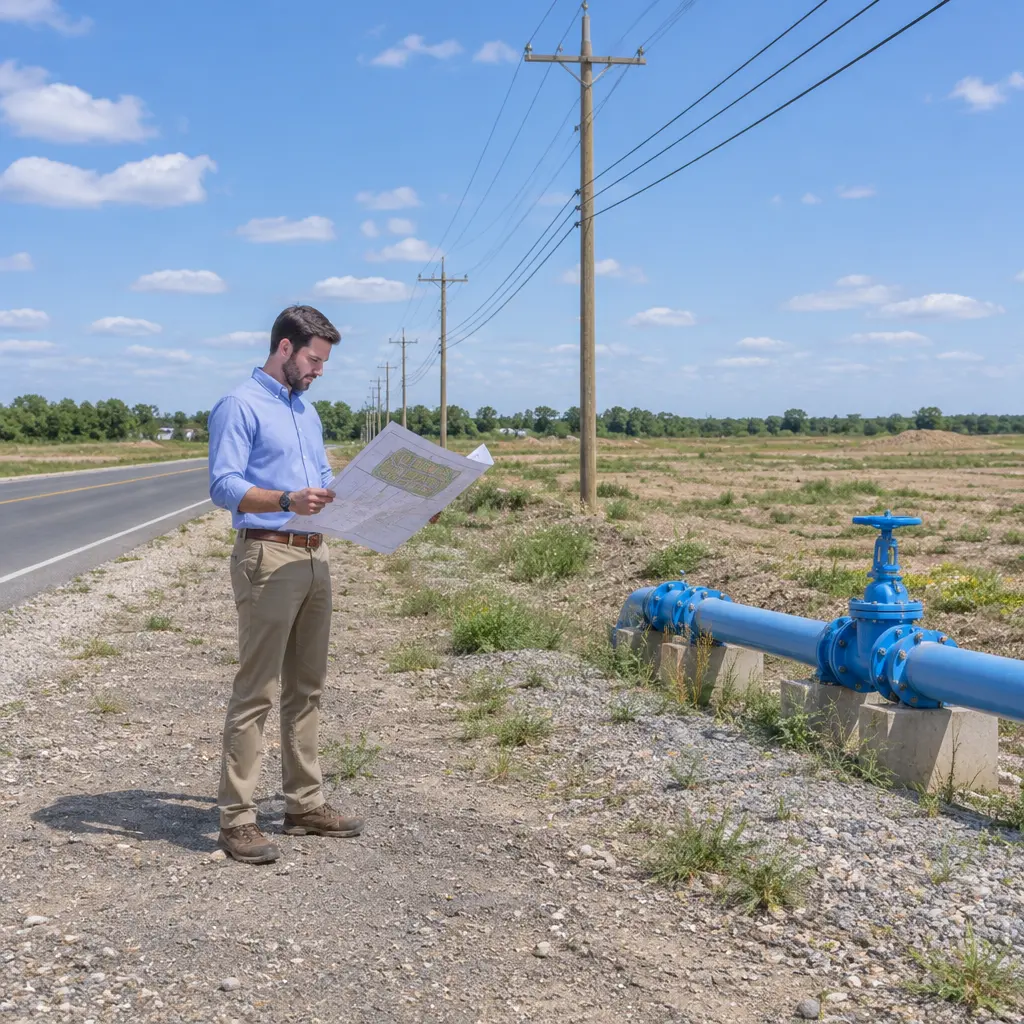
Vacant-land utility due diligence is the process of confirming whether water, sewer, electricity, gas, telecommunications, and stormwater services are physically available, legally accessible, adequately sized, and affordable for a proposed use. Before relying on zoning assumptions or purchasing land, buyers should obtain written confirmation from utility providers, verify connection routes and easements, and identify capacity, permitting, and extension costs. A parcel’s zoning designation does not establish utility service: the U.S. Environmental Protection Agency notes that public water and wastewater systems are regulated separately from land-use decisions, while local governments and providers set their own connection requirements. Because utility extensions can materially affect project feasibility and value, verification should be treated as a pre-approval and pre-closing task, not a post-entitlement assumption.
Utility Access Verification Defines Vacant-Land Due Diligence
Utility access verification means documenting the service, capacity, legal rights, and costs required to serve a specific parcel and intended development. It is more than seeing a power line or water main near the property. A line may be on the wrong side of a road, lack available capacity, require a costly extension, or be inaccessible without an easement. Likewise, a parcel shown as residential or commercial on a zoning map may still lack approval for a private well, septic system, or utility connection.
The key distinction is between proximity and serviceability. Serviceability requires confirmation that the provider will serve the parcel, that the proposed use can be connected at the required load or flow, and that necessary permits and rights can be secured. The U.S. Environmental Protection Agency’s Safe Drinking Water Act materials describe public water systems in terms of the people served and system operations; they do not guarantee that every nearby property has a connection or spare capacity. Local provider rules and project-specific engineering therefore matter.
Physical availability and connection points
Physical availability identifies whether a usable main, line, or network connection exists and where the provider will permit a tap or service entrance. Confirm the exact location, pipe or line size, pressure or voltage requirements, distance to the parcel, road-crossing needs, and whether the apparent infrastructure is active. Utility maps, field locates, and provider records can differ; request current written information rather than relying on a listing, aerial image, or seller statement.
Capacity and intended-use compatibility
Capacity is the provider’s ability to furnish the quantity and quality of service required for a particular project. A single-home connection and a subdivision, warehouse, or industrial operation can have very different water demand, wastewater flows, fire-flow needs, and electrical loads. Ask providers to assess the actual proposed use and preliminary demand, and request any conditions, system upgrades, impact fees, or required studies in writing. A “line nearby” statement is not a capacity commitment.
Legal access and service rights
Legal access means that the owner can lawfully install, maintain, and repair service facilities between the parcel and the utility network. The route may cross another owner’s land, a public right-of-way, a drainage area, or land subject to restrictions. A title commitment, recorded plat, easement documents, and provider requirements should be reviewed together. The American Land Title Association’s survey standards distinguish matters that may be revealed by a survey from rights and restrictions established in public records; a boundary survey alone does not grant an easement or guarantee a utility connection.
Once physical, capacity, and legal questions are separated, due diligence can evaluate each service type using the records and technical review appropriate to that system.
Utility Due Diligence Tests Water, Wastewater, Power, and Communications
Water: public main, well, and fire-flow review
Water due diligence determines whether the parcel can obtain a reliable supply for domestic, irrigation, process, and fire-protection needs. For public water, ask the provider about a service letter, connection point, meter size, pressure, available flow, tap fees, and any main extension or upgrade. For a private well, consult the state or local health department about well permits, setbacks, testing, groundwater conditions, and any applicable water-use restrictions. The U.S. Geological Survey explains that groundwater availability varies with geology, recharge, and pumping; a neighboring well is not proof that a new well will yield adequate water.
Wastewater: sewer connection or onsite septic
Wastewater review establishes whether sewage can be conveyed to a public system or managed onsite. For sewer, confirm connection eligibility, lateral location, gravity-flow feasibility or pumping requirements, treatment capacity, capacity charges, and any pretreatment rules. For septic, obtain a site and soil evaluation from the authority having jurisdiction; system feasibility can depend on soil permeability, groundwater depth, slope, setbacks, and reserve-area requirements. The U.S. Environmental Protection Agency reports that more than one in five U.S. households rely on septic or other decentralized wastewater systems, underscoring that onsite treatment is common but not automatically suitable for every parcel.
Electricity and gas: load, route, and extension cost
Electric and gas verification addresses whether the serving utility can provide the required load or volume, at the desired service location and schedule. Obtain written information on the serving utility, available voltage or service type, transformer and line-extension needs, natural-gas availability, construction lead times, contribution-in-aid-of-construction charges, and ongoing tariffs. For larger projects, request a preliminary load study and confirm who pays for upgrades. The U.S. Energy Information Administration’s reporting on electricity infrastructure and delivery highlights that the existence of a regional grid does not mean a particular parcel has a distribution connection or adequate local capacity.
Telecommunications and broadband
Telecommunications due diligence checks the actual service options at the parcel, including wired broadband, fiber, cable, fixed wireless, and cellular coverage. The Federal Communications Commission’s National Broadband Map is useful for identifying reported availability, but map coverage is not the same as a provider’s binding service commitment, installation feasibility, or guaranteed performance. Contact providers directly about construction charges, capacity, speeds, service-level terms, and whether a private extension is needed.
Stormwater and drainage infrastructure
Stormwater is a development utility in the practical sense because drainage facilities, outfalls, and approvals can determine whether a site can be built as planned. Review the local stormwater manual, drainage easements, flood information, downstream outfall rights, detention or retention requirements, and maintenance obligations. The Federal Emergency Management Agency’s Flood Insurance Rate Maps identify mapped flood hazards, but they do not replace a site-specific drainage study or guarantee that a proposed discharge will be approved.
Together, these service investigations establish whether a parcel is merely zoned for a use or can realistically support it. The next step is to reconcile utility findings with zoning, subdivision, building, and environmental approvals.
Zoning Approval Does Not Guarantee Utility Service
Zoning regulates permitted land uses and development standards; utility providers control or administer service availability, connection conditions, and infrastructure requirements. A zoning approval, conditional-use permit, or preliminary plat therefore should not be interpreted as a commitment to provide water, sewer, power, or other services. Conversely, a utility provider’s willingness to serve does not establish that the proposed use is allowed under zoning.
Separate approvals, separate decision-makers
A project may require decisions from a planning department, public works agency, water or sewer district, electric utility, environmental regulator, and road authority. Each decision can have different application materials, review timelines, and appeal or expiration rules. Ask the planning authority which utility documents are required for zoning or subdivision review, and ask each provider whether its preliminary response is advisory, conditional, or binding.
Capacity constraints and offsite improvements
Even where facilities are nearby, constrained treatment plants, undersized mains, transformer limitations, or unavailable rights-of-way can require upgrades. Those costs may include engineering, easement acquisition, road restoration, pumping equipment, or oversizing facilities for future growth. The American Society of Civil Engineers’ infrastructure assessments routinely document investment and condition challenges across U.S. infrastructure sectors; they are useful context, but only the relevant local provider can confirm project-specific capacity and cost.
A practical example: the “nearby sewer” assumption
Consider a parcel marketed as suitable for a small commercial development because a sewer main appears along the adjacent road. Due diligence may reveal that the main is at a higher elevation than the site, so a pump station is required; the sewer district may also require a capacity review and an easement across a neighboring lot. In this situation, zoning compatibility does not remove the engineering, cost, or legal-access hurdles. The example illustrates why written provider responses, preliminary engineering, and title review should precede reliance on a development schedule or land valuation.
A Documented Verification Process Reduces Land Risk
1. Define the proposed use and demand
Prepare a concise project description with intended uses, unit count or floor area, anticipated occupancy, water and wastewater demand, fire-flow needs, and electrical load. Providers cannot give a meaningful capacity response without knowing the scale and type of development being evaluated.
2. Identify every provider and regulator
Contact the relevant water and sewer utilities, electric and gas providers, telecommunications companies, road authority, health department, and stormwater authority. Confirm service territories directly; utility boundaries do not always follow municipal boundaries or mailing addresses.
3. Obtain written, parcel-specific responses
Request letters or emails identifying the parcel, proposed use, available connection points, capacity assumptions, required studies, fees, extension responsibilities, easements, and conditions. Ask how long the response remains valid and whether capacity is reserved or merely estimated. A verbal statement should be treated as an initial lead, not a commitment.
4. Check title, survey, and route feasibility
Have a qualified title professional and surveyor review the legal description, recorded easements, encroachments, access, and proposed utility corridors. If facilities must cross third-party land, determine whether an easement already exists or whether a new grant is realistically obtainable. Confirm road-opening and crossing permits with the relevant authority.
5. Price extensions and schedule constraints
Ask for itemized estimates covering connection fees, engineering, construction, upgrades, restoration, meters, inspections, and recurring charges. Obtain a realistic schedule for studies, easement negotiations, procurement, and construction. Estimates should be identified as preliminary and updated as design details become available.
6. Make the transaction conditional on findings
Where feasible, negotiate due-diligence periods, utility-approval contingencies, access to conduct tests, and rights to terminate or renegotiate if service is unavailable or costs exceed agreed thresholds. Have local land-use counsel review contract language and confirm that zoning and utility conditions are not conflated.
- Record each provider’s name, contact, date, parcel identifier, and written response.
- Separate confirmed facts from estimates, assumptions, and unresolved approvals.
- Track physical connection, capacity, legal route, cost, and schedule for every service.
- Reconfirm material utility commitments before closing and before final engineering.
Conclusion: Verify Utility Access Before Treating Zoning as Feasibility
Vacant-land due diligence should test utility access across five connected attributes: physical availability, capacity, legal access, cost, and timing. Water, wastewater, electricity, gas, telecommunications, and stormwater each involve different providers and technical standards. Zoning approval addresses land-use permission, not guaranteed service, and nearby infrastructure does not prove that a parcel can connect affordably or legally.
Before purchasing land or relying on an approval assumption, define the proposed demand, obtain parcel-specific written responses, review title and easements, and price required extensions. Start with the local planning office and utility providers, then involve qualified civil engineers, surveyors, title professionals, and land-use counsel where needed. Early verification can expose fatal constraints while there is still time to renegotiate, redesign, or walk away.
Sources: U.S. Environmental Protection Agency, Safe Drinking Water Act (SDWA), https://www.epa.gov/sdwa; U.S. Environmental Protection Agency, Septic Systems Overview, https://www.epa.gov/septic; U.S. Geological Survey, Groundwater Information, https://www.usgs.gov/mission-areas/water-resources/science/groundwater; American Land Title Association, ALTA/NSPS Land Title Survey Standards, https://www.alta.org/land-title-survey-standards; Federal Communications Commission, National Broadband Map, https://broadbandmap.fcc.gov/home; Federal Emergency Management Agency, Flood Maps, https://www.fema.gov/flood-maps; American Society of Civil Engineers, 2025 Report Card for America’s Infrastructure, https://infrastructurereportcard.org/; U.S. Energy Information Administration, Electricity Explained: How Electricity Is Delivered to Consumers, https://www.eia.gov/energyexplained/electricity/delivery-to-consumers.php


